
psalm 25-28 — sikkim
After a triplet of Psalms that powerfully reveal the escalating ministries of the Messiah (Psalm 22 = SACRIFICE for sinners; Psalm 23 = PASTOR of His people; Psalm 24 = KING of the Whole Earth), Psalm 25-28 reveal powerful truths about the God of Israel that so clearly distinguish Him from Allah of the Quran and the false gods of men. Many of the secular Israelis I have spoken to about the things of God over the years have made the claim that the god of Islam and the God of the Bible is the same God. Many times, I have responded: “The god of Islam is IN THE BIBLE, but He IS NOT the God of the Bible. He is the “nachash” (I.e. serpent) in the “gan eden” (Garden of Eden). Of course, they know exactly what these Hebrew words mean. Often, the mouth drops, and the hearer responds: “I can’t believe you said that.” But alas, it is true, and I make no apologies.
Allah of the Quran is distant and unknowable, as is the Hindu pantheon and the so-called Buddha that the Tibetan Buddhists definitely worship. I’m not sure what is dumber, riding around alone in your car with a mask on to “protect” you from covid-19, or the statement I have so often heard from American college students: “Buddhism isn’t a religion, it is a state of mind.” LOL.
Viewing the Scriptures in landscape mode (i.e. as opposed to portrait mode) again reveals powerful truth. Psalm 25-28, it can be said, go together, for each successively reveals an aspect of God’s character that cannot be found in the Quran or from the idols of manmade religion. And, this revelation is quite simple. For all my Israeli friends, the god of the Quran IS NOT:
A REVEALER OF SECRETS to anyone or all who fear Him (Psalm 25).
LOVINGKINDNESS amidst judgment (Psalm 26).
A HIDING PLACE along PLAIN PATHS (Psalm 27)
SAVING STRENGTH (Psalm 28).
The God of the Bible reveals secrets while Allah keeps them to himself. The God of the Bible, the God of Israel, openly displays His lovingkindness while the “most merciful” part of Allah has to be searched out as is a needle in a haystack. Allah is a storm. The God of the Bible is a furious storm and yet also the shelter from that storm, a hiding place. Allah may be strong, but the God of the Bible is saving strength for the weak and downtrodden.
Because of these things, we can find edifying peace in something as trivial as a morning jog when the opposite of everything we have prayed for in a certain situation has come to pass.
Back in January of 2007, Jamie and I transported 2-year-old Bethany and a load of Bibles and Christian material over the border in Eastern Nepal and up to Darjeeling in Northeast India. I had been wanting to visit Darjeeling, and some missionaries living there needed the delivery. I remember there was some sort of strike or political protest going on in Nepal at the time, and the airport in Eastern Nepal was 20 miles from the Indian border. We were therefore three overloaded bicycle rickshaws on a long, long ride the afternoon, and we arrived at our destination in the pouring rain very, very late at night. While Jamie and Bethany stayed back with a missionary family in Darjeeling, I decided to travel up into Sikkim, a restricted area in Northeast India somewhat like Ladakh in the Northwest and Tibet in China. In fact, the people of Sikkim, years ago, ceded themselves to India so what the Chinese did to the Kingdom of Tibet wouldn’t happen to them. It’s a strange political arrangement. I had high hopes for that journey into Sikkim, and the LORD granted me the permit to travel there alone. But, after I returned to my family in Darjeeling some time later, it seemed as if the opposite of everything I had prayed for came to pass. I was discouraged. But, the God of the Bible whom I serve isn’t like the god of the Quran or the Buddha worshipped by the people in Sikkim.
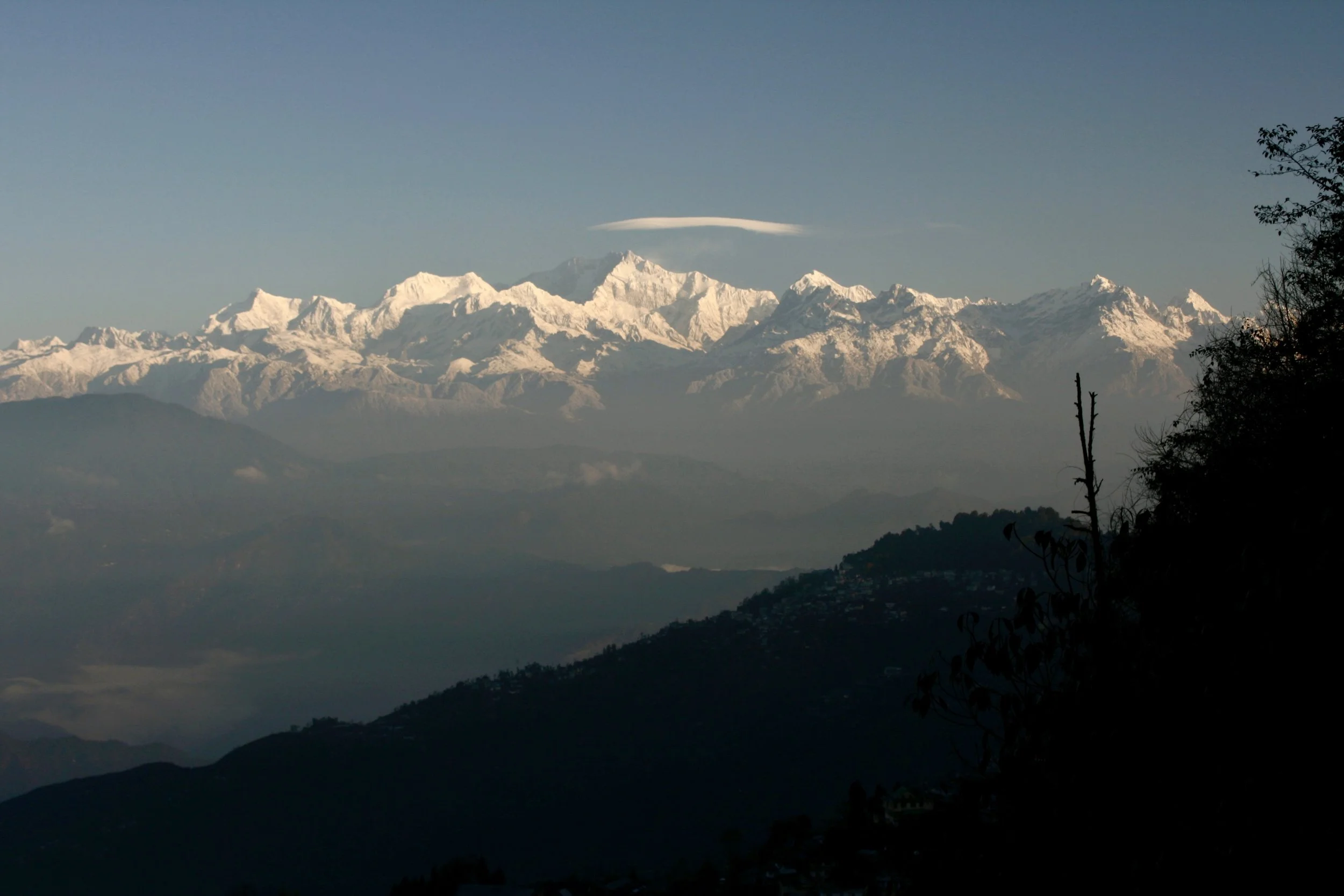
I went for a run on the wet streets of Darjeeling during a break in the rain, and strangely, even though the mighty Kanchenjunga (the world’s 3rd highest mountain) was completely shrouded as it had been since our initial arrival, I found peace, and my spirits were lifted. I penned these words in a journal that February 8th afternoon:
“ . . . So, I went to bed last night in a bad mood, unable to glean much positive from that entire trip up into Sikkim. It seems like the opposite of everything I prayed for came to pass. I felt a little better with the coming of the dawn, but still, I search for meaning and purpose. I suppose many more could have heard the Gospel had I taken better charge of some of the situations encountered up there. It was hard laboring alone without another bold brother of like faith at my side. But, going for a run, even in the intermittent rain, was spiritual medicine for me this morning. I gave out a few Gospel tracts along the way and shared Christ boldly with three young men who were getting ready to light up some doobies . . . I guess there were good things that occurred during my time in Sikkim. Anytime the Gospel goes out, the effort is not in vain. I am still hoping to see Kanchenjunga before we leave. There are only clouds to the west.”
I tasted God’s lovingkindness on that run. He revealed to me secrets available to any who fear Him. He was a hiding place along a running path, and in that hiding place, I found saving strength . . . just like the Psalmist of Israel.
And to top it all off, I was able to pen these words just a few days later:
“Things have much improved for me spiritually since that run. And, there have been witnessing opportunities. I think of that group of young Buddhist monks and the old man who walked up as darkness fell. And praise be unto God, for the Himal were finally unveiled in their hoary white glory. Kanchenjunga stood out stark at over 8,000 meters. I believe I have now beheld eight of the world’s fourteen 8000-meter peaks with my own eyes.”